
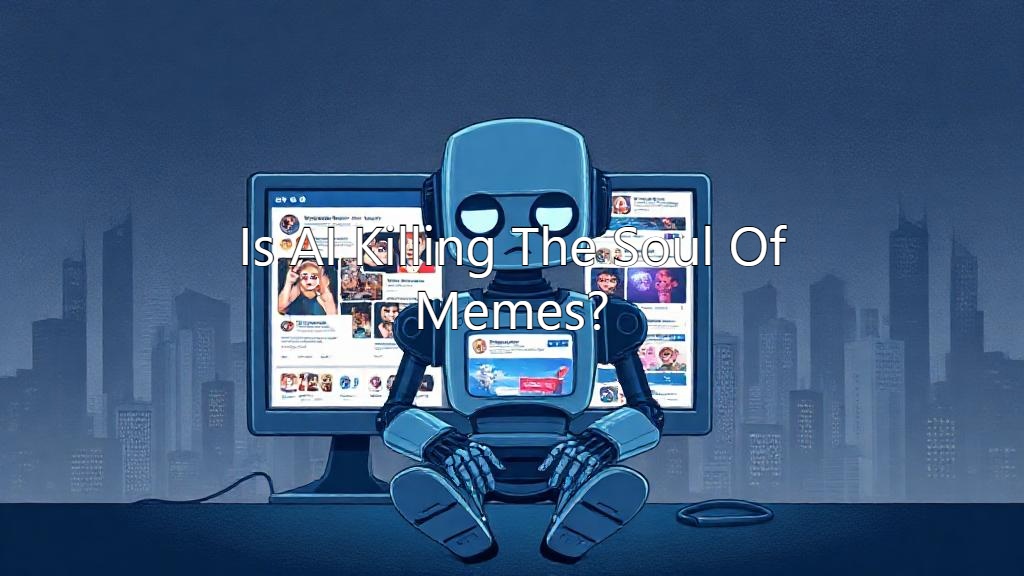
Memes have always been the internet’s inside jokes—raw, relatable, and born from human creativity.
But with AI now churning out memes at lightning speed, many are starting to wonder.
Does this new wave of machine-made humour strip away the authenticity that made memes so culturally powerful in the first place?
While AI brings efficiency and endless variations, it also raises questions about originality, emotional depth, and whether something crafted by an algorithm.
It can never truly capture the messy, human essence of humour.
From Relatable Humour To Robotic Output: How AI Is Changing Meme Culture
Source: Pexels
Memes used to feel like snapshots of collective human experience—an inside joke shared across millions who instantly “got it.”
Whether it was a reaction image, a clever caption, or a viral trend, memes thrived because they reflected real emotions, social struggles, and cultural quirks.
With the rise of AI, however, this process is changing.
Tools like ChatGPT, MidJourney, and other meme-generating platforms can now produce content instantly, but often at the cost of authenticity.
Instead of emerging organically from communities, many AI-generated memes are built on pattern recognition and recycled tropes.
They may look funny on the surface, but often lack the deeper layers of relatability or social commentary that make a meme stick.
AI’s speed and accessibility do open the door for anyone to create, but the risk is that memes become mass-produced, formulaic, and stripped of the messy human touch.
In short, while AI can generate laughs, it risks turning memes from cultural artefacts into disposable content.
The Rise Of AI-Generated Memes: Convenience Or Creativity Killer?
One of the biggest appeals of AI-generated memes is convenience.
Anyone can type in a prompt, and within seconds, an endless stream of meme templates, captions, and formats appears.
For casual users, this feels like a shortcut to internet humour without the effort of brainstorming or editing.
In a world where trends move at lightning speed, AI offers a way to stay relevant without spending hours on Photoshop or waiting for inspiration to strike.
But this convenience comes with trade-offs.
True meme culture has always thrived on originality and subversion—flipping expectations, making niche references, and capturing specific moods that AI often misses.
By leaning too heavily on automation, memes risk losing their edge and becoming repetitive or hollow.
A joke crafted by thousands of human brains online feels alive; one churned out by a machine feels disposable.
AI has created a fast-food version of meme culture: quick, accessible, and everywhere—but lacking the substance that made memes meaningful in the first place.
The question now is whether convenience will outweigh creativity, or if audiences will eventually crave the authenticity that only human humour can provide.
Why Human Humour Still Outshines Machine-Made Jokes
Source: Pexels
At its core, humour is deeply human—it’s shaped by lived experiences, cultural nuances, and unspoken contexts that machines struggle to grasp.
A meme is funny not just because of the image or words, but because it taps into a shared moment of recognition.
The awkward silence on a first date, the chaos of group projects, or the absurdity of modern life.
AI, on the other hand, generates humour by remixing data.
It recognises patterns and mimics punchlines, but it doesn’t understand why something is funny in the first place.
This difference shows in the memes themselves.
Human-made memes often carry layers of irony, satire, or cultural critique—qualities that spark conversations and even influence trends.
AI-generated memes may look polished, but they often miss the subtle timing, sarcasm, or emotional undertones that make humour truly land.
For example, a human might turn a breaking news event into a viral meme within minutes, using wit to reflect collective feelings.
AI can imitate the format, but it can’t capture that spontaneous, human spark..
The Ethics Of AI In Meme Creation: Who Owns The Laughs?
As AI tools continue to generate memes at scale, an important question arises: who actually owns the content?
Traditional memes often borrow from pop culture, public figures, or viral moments.
But when humans remix these, there’s usually a layer of creativity, satire, or commentary that makes them transformative.
With AI, the process becomes murkier.
If an algorithm produces a meme based on prompts, is the credit due to the user who typed the words, the developers who trained the model, or the countless creators whose work the AI learned from?
This raises ethical and legal challenges.
AI systems are trained on massive datasets that include memes made by real people, often without credit or consent.
In some cases, AI might replicate styles or ideas so closely that it blurs the line between inspiration and plagiarism.
Beyond ownership, there’s also the risk of misuse—AI can easily generate offensive, harmful, or misleading memes at scale, amplifying disinformation under the guise of humour.
At its best, meme culture thrives on community-driven creativity.
But when machines step in, the risk is that the “soul” of memes—built on shared human expression—becomes commodified, raising the question of whether laughs can truly be owned.
The Future Of Memes: Can AI And Humans Coexist In The Memeverse?
Source: Pexels
Despite the growing concerns, AI doesn’t necessarily have to spell the end of authentic meme culture.
Instead, it could evolve into a tool that complements human creativity rather than replacing it.
Just as Photoshop and video-editing apps expanded the possibilities of digital expression.
AI could provide new ways for meme makers to experiment—speeding up production, suggesting formats, or even sparking inspiration when creativity stalls.
The key lies in how it’s used.
If meme culture leans too heavily on AI, there’s a risk that humour becomes formulaic and detached from real human experiences.
But if creators treat AI as a collaborative partner, the memeverse could actually expand, blending the efficiency of machines with the nuance of human wit.
Imagine AI providing the raw template while people add the punchlines that reflect genuine cultural moments.
As audiences, we crave authenticity as much as we enjoy convenience.
Memes born from human connection will always hit harder.
But AI might just help push the culture into new, unexpected territories—so long as we remember that laughter, at its core, is a human trait machines can only imitate.
Related To Memes: